
Career Paths in IT: From Graduate to Tech Lead
A practical roadmap to growing in IT—from your first job to leading teams and building scalable systems.

How do I start a career in IT in 2026? Is it too late with AI?
These are valid questions. There are many sources to clarify these doubts on the internet, however none of them relevant to the Sri Lankan context.
These are the contents in this guide. You can read it from the start to finish and come back to the necessary sections when needed.
- Is IT a good career in 2026?
- Why start a career in Information Technology?
- What does career flexibility in IT actually look like?
- How to start an IT career in Sri Lanka
- Do I need a degree to get an IT job in Sri Lanka?
- How do you grow from a graduate to a Tech Lead?
- Conclusion: What should you remember before you start?
Either way, by the end of this guide, you will have a clear idea on how to start and walk in your journey.
Is IT a good career in 2026?
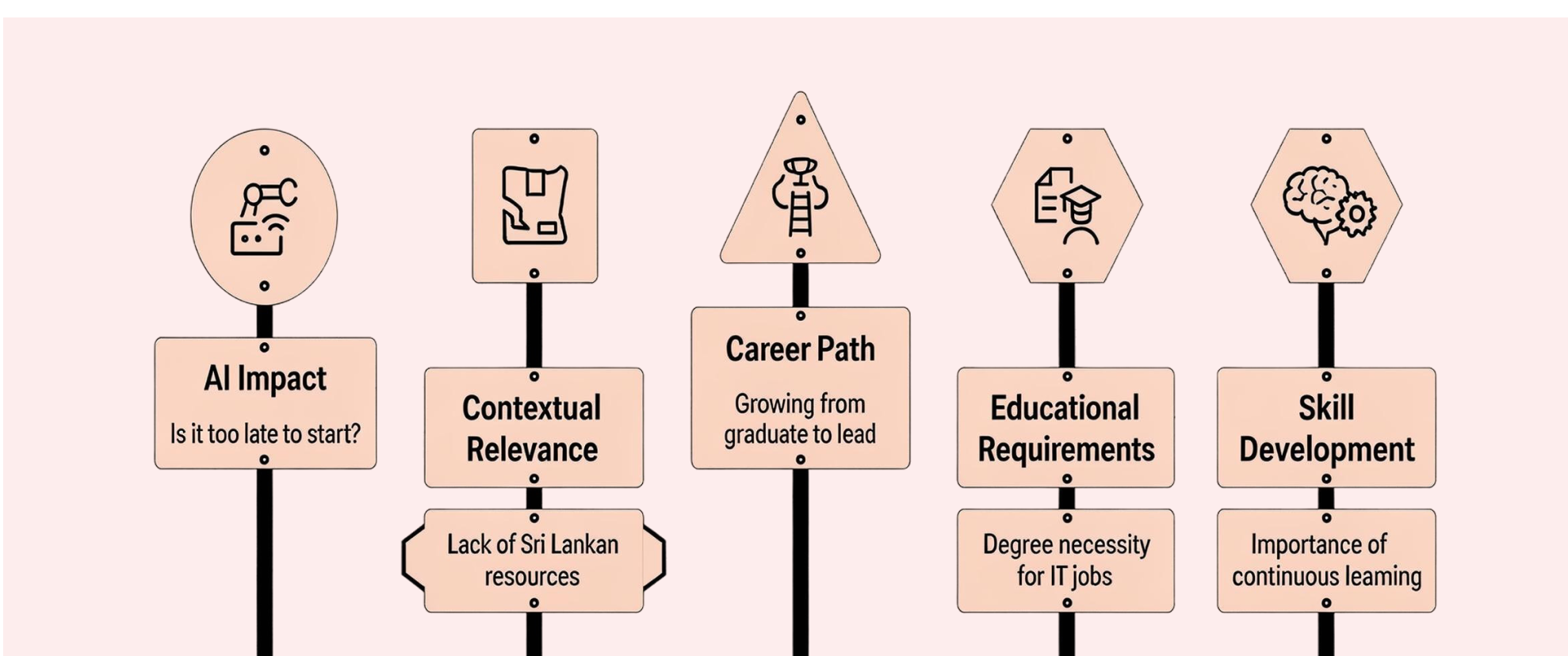
Artificial intelligence is altering the global workforce across all the industries. IT being one of the largest industries, is subjected to immense change due to AI. This has caused the laying off and redundancies in certain job roles.
Based on statistics from the Silicon Valley Business Journal, over 184,000 IT employees have been laid off in 2025 alone due to the impact of AI. With this knowledge, can IT still be a career worth investing and beginning?
Yes! It’s no longer limited to maintaining systems. With digitalisation organisations have started to rely on technology to reach business outcomes that can be measured, such as improving efficiency, customer satisfaction through products and services and innovation.
Why Start a Career in Information Technology?

- Strong demand
- Competitive salary
- Career Flexibility
This has led to the rise of the bar. Professionals and novices are now expected to display skills beyond their roles and play a role in strategic decision making.
Strong demand
The demand for professionals remains high due to the incorporation of technology in every other aspect of a company that leads to its success.
In Sri Lanka this demand is observed through,
- The growth of software companies
- Increase in outsourcing services
- Rise in cloud technologies
Competitive salaries
This is one of the industries that offer a vast range of salary potential in Sri Lanka. Although the salary ranges for an entry level intern may be between 25,000 to 30,000 LKR, the salary for mid levels and senior levels can vary from 110,000 to 500,000 LKR per month.
With the increment in remote and hybrid roles, it can increase the earnings significantly.
Career flexibility
This field has multiple opportunities, with many different fields to choose from. You’re not pigeonholed to one specific path alone. As you gain experience and knowledge, you can move between different roles to find what aligns with your interests and strength.
Below is a breakdown of the main areas and a few types of roles you can move into within each.
Software development roles
- Front-End Developer (UI/UX, user interfaces)
- Back-End Developer (server-side logic, databases)
- Full-Stack Developer (front-end + back-end)
- Mobile App Developer (Android/iOS)
- Software Engineer
IT support and infrastructure
- Help Desk Technician
- IT Support Engineer
- Desktop Support Specialist
- Systems Administrator
- Network Administrator
- IT Manager
Cybersecurity
- Security Analyst
- Security Engineer
- Penetration Tester (Ethical Hacker)
- Incident Response Specialist
- Security Architect
- Chief Information Security Officer
Cloud Computing & DevOps
- Cloud Engineer
- Cloud Support Engineer
- DevOps Engineer
- Site Reliability Engineer (SRE)
- Cloud Architect
Data science, AI & Machine learning
- Data Analyst
- Business Intelligence Analyst
- Data Scientist
- Machine Learning Engineer
- AI Engineer
How to start an IT Career in Sri Lanka

Where should you start if you have no IT background?
- Research the industry and the different fields in the industry.
Understand what kind of work aligns with your interests. There are few things that you should pay attention to while you do thois research such as,
- The return in the field
- The local opportunities available with the pay
- The global opportunities
- The impact of AI on the field
Once you know these, choose a field to invest time and energy in.
- Learn the necessary skills
One thing most beginners do wrong is trying to learn every skill required for a field at the same time. This leads to a shallow understanding of many subjects which can serve no purpose to you or a company that hires you.
Therefore choose one skill, learn and strenthen your knowledge in the specific field initially. As you gain experience, you’ll gain the opportunities to expand your skillset.
- Talk to people in the field
Networking is one of the most important steps when starting a career in tech. Talk to people already in the industry to gain insights and knowledge to see if it’s worth investing in.
Do I need a degree to get an IT job?
In Sri Lanka, it depends.
You can still get a job without a degree but with the current demand, the minimum qualification expected by respected companies is a degree. Holding a degree gives you more opportunities with better salaries offered after 6 months if you’re a beginner.
Most companies hesitate to hire employees without a degree, while you may still find opportunities in startups and small scale businesses.
However, certain qualifications such as different certificates can help you begin a career in IT. Even so obtaining a degree later is recommended to proceed in the field due to the benefits it can provide in your career.
How to grow from a graduate to a Tech lead?
Who is a graduate? A graduate is anyone who holds a degree.
While a degree can be helpful in many ways, what can make you a tech lead goes beyond a qualification on paper. To become a lead it requires many skills including both tech skills as well as soft skills. Commitment, dedication, leadership, discipline, management skills, etc are main skills a leader must have.
Once you complete an year or 2 learning the fundamentals and getting your hands dirty, choose a field that you want to specialize in. While you grow your skills in this journey of your specialization, improve on your soft skills.
These can help you project into higher leadership roles in the company that you work for.
Conclusion
If you skimmed through this blog, here’s the main idea in this guide:
Starting a career in IT in Sri Lanka in 2026 is a smart choice, however it’s important to know that you don’t have to know everything.
Yes it’s a challenging industry, but with the strategic approaches and the right guidance, it can be a rewarding one.
The industry continue to grow with plenty of opportunities even with AI. What has changed currently is the expectation from employees. Employers are looking for people who can understand problems and create proper solutions.
You begin by,
- Understanding the different paths
- Choosing a direction you’re nterested in
- Learning and growing
From there onwards, your goal is to enter the industry through your first job, internship or opportunity. Once you are in, remember that your career will not follow a steady fixed path. You will learn, adjust, switch careers and move between roles as you grow.
This is the nature of IT.
You don’t need to have everything planned out from the beginning. You just need clarity on where your first step should be placed. If you choose to take one thing from this guide, let this be it:
You can start with no knowledge, but you cannot grow iwthout acting.